Blog 8: Government

Costa Rica, like I have said many times is known to be the Switzerland of Central America. They are a “democratic, free and independent republic”. Similar to the United States, they have three separate but equal supreme powers:  Executive Power, Legislative Power and Judicial Power. The current President is Mr. Carlos Andrés Alvarado Quesada and the Vice presidents are Ms. Epsy Campbell Barr and Mr. Marvin Rodríguez Cordero. Firstly, I know this will never happen in the US but the president and I have the same last name! Which I think to be pretty awesome and the fact that there is a woman vice president.

The Executive Branch is structured similar to that of the US. It is run by the President, their vice presidents and cabinet. The President elects his vice presidents and cabinet as they serve their term, which is elected by popular vote. Costa Rican presidents as of 2005 were only allowed to serve one term, but with Oscar Arias Sanchez, who had served as President 1986 caused for the reformation of the Constitution. Presidents, if re elected, are allowed to serve more than one term. However, they catch with that is that they must sit a term out and then be re elected. The terms cannot be won consecutively as well as served consecutively. Since then, Oscar Arias Sanchez, has been the only President to be re elected and who the Nobel Peace Prize. The roles of Presidency are limited, which is not the case in the US. They cannot veto the legislative budget however, they are able to appoint whomever they want to their cabinet without Congress’s say. In regards to the two vice presidents, which is similar to that of the US except we call one “Secretary of State”.

The Legislative Branch holds 57 seats in it. Members are again, elected by popular vote to serve four year terms. In comparison to other countries in Central America, Costa Rica’s Legislative Branch has more power than any other country has given to theirs. The Commission is divided into six and are responsible for reviewing proposed laws. Each Commission section have specific branches on laws that they will review. These sections are: Agriculture & Natural Resources, Economic Affairs, Government & Administration, Budgeting & Taxation, Judicial Affairs, and Social Affairs. I think this is significant to note as I do not believe the US has a system so organized. Members are organized as well. There are a set amount of seats that are set aside for women, and other minority groups for their representation as well. I found this to be amazing! Why is that not a concept that we in the US consider? I know why! Because we love white men in power, that’s why!

Finally, the Judicial Branch is the legal system in Costa Rica and completely independent from the other two branches. There are three levels of court: district, appellate and supreme. All fairly simple to understand as the deeper you get in court, the higher you go up in the levels of court. However, the Judicial Power is exercised by the Supreme Court of Justice, who is currently: Carlos Chinchilla Sandí. The Supreme Court of Justice is allowed an eight year term and may be re elected, consecutively for potentially their who life.

Journal 7: Additional Questions

Some additional questions about further interactions are: What significance does being a US American have to a person from your host country? Are we viewed as having a lot of money? And how might media stereotypes about US Americans affect how a potential person looks at us? These questions have significance to me because as I want to fully immerse myself in the Costa Rican culture I believe that these will hinder my ability to do so. But I will try my best to understand how the image of US Americans will affect me.

What significance does being a US American have to a person from your host country?

The significance of being a US American can have a negative or a positive effect on the person. There can be differences in cultural norms and values that may not be compatible in their host country. While the cultural norms and values are somewhat similar to those of Costa Rica there may be slight instances that they do not match up and you have to be able to adapt in the situation. There may also be instances that people from your host country have preconceived ideas about what it means to be a US American by other people they have met, media, or other examples of US Americans. In those instances that may affect you negatively or positively based on the people you meet in your host country. If they have experienced a US American that may work in your favor and connect with the person because you have something in common.

Are we viewed as having a lot of money?

Yes. And because the dollar is worth more than the colon, the Costa Rican currency people are going to automatically look at us differently. In addition, from personal experience the fashion in Costa Rica is upcoming and they are very much into brand named things such as Nike, Adidas and other popular brands. These brands for us in the US, while they are expensive they are easily purchased while in Costa Rica the brands are costly due to importation. A majority of us have these brands and unknowing to us, people in Costa Rica will notice these brands and see us for having money because they are so hard to purchase in Costa Rica. This may be a caution to us when in Costa Rica to be aware of.

How might media stereotypes about US Americans affect how a potential person looks at us?

This question in my own opinion is the most important. As long as Donald Trump is our president Costa Ricans will continue to make fun of us. The fact that Costa Rica is known as the Switzerland of Central America makes for the stereotype that all US Americans are loud, rude and laughable people. In addition, movies can be a huge contributor to stereotypes of US Americans. Movies such as Project X, and Spring Breakers show US Americans as party-animals and loud people which can mean that people think we just like the movies portray us to be.

Blog Post: Fooooood

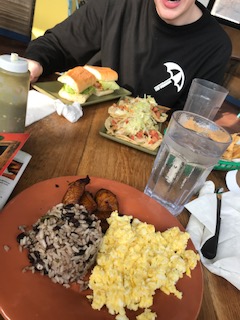
I traveled to the only Costa Rican restaurant in the Chicagoland area. It is called Irazu and is in Bucktown and not to far of a bus ride from the train station. I went and felt like I was at home. I ordered many things but 3 that were my favorite were: patacones con frijoles (English: smashed and fried plantains with beans), gallo pinto (English: white rice and beans with eggs) and yuca fries.

Patacones con frijoles is a typical Costa Rican appetizer that I as a kid and still eat as a full meal. The plantanes are smashed into circle-like shapes and then fried either with a ton of oil on a pan or deep fried. They are then plated next to a bowl of refried black beans to either dip or put on top of the plantains. The beans are refried, smashed black beans, seasoned with salt and unions. Typically Costa Rican food is not spicy at all and the food at Irazu was very well made. They went together perfectly even though the plantains were a bit over cooked.
Next, the gallo pinto was my favorite dish at the restaurant. I am a vegetarian and I typically never eat eggs but I felt that I should give it a try. I normally just eat eggs on their own when I am in Costa Rica because I feel that they are healthier and fresher. Gallo Pinto is a traditional breakfast meal and so far from what is typical of breakfast in the US. Gallo pinto is white rice and black beans with eggs. I prefer to have scrambled eggs but others can have them over easy or  sunny side up. The history behind the rice and beans is that they were most likely leftovers from the day before and they would be mixed and heated over again for breakfast the next morning. The rice is a little firmer and the beans are not as juicy which create the perfect leftovers. The combination of the eggs create a breakfast like meal and thus gallo pinto became a staple breakfast in the Costa Rican household.
Finally, the yuca fries are not just traditional to Costa Rica but of many Caribbean and Central American countries. Yuca fries can be prepared many ways but the most familiar and most seen in Costa Rica are prepared with thick pieces of fried yuca. The fries that were prepared at Irazu were not typical of Costa Rican yuca fries. The fries were thin and deep fried to make more of a chip. I still dipped them in refried beans which is used mostly as a salsa like dish but I was not a fan. The Costa Rican yuca chips are comparable to diced potatoes just to get a better understanding of what they are meant to be like in Costa Rica.

Overall, I very much enjoyed Irazu and will be definitely going back. I was given the opportunity to meet the owner and he gave us a little Costa Rica discount. I was excited to find Irazu and to have my boyfriend join me.

Blog Post: “El Mayordomo”

Costa Rica does not have many movies from their own country but rather has movies translated to spanish from popular movies in the US. However, I did find the movie called “El Mayordomo” which means “The Butler”.

The movie is about a boy named Peter who is from Costa Rica and received the house of his recently deceased mother. She left the house for him in his will which is very common in Costa Rica for homes to be passed down from generations. The house comes with the butler and his daughter that worked for Peter’s mother and when Peter plans on cleaning out the house he notices that they have something else in mind. The plot thickens when things get creepy. I won’t ruin the movie but I definitely closed my eyes a couple of times.

The movie is rated “Terror” which is “R” in Spanish and I could easily find the movie online, maybe illegally, but found it nonetheless. The movie was released in 2017 and to date is the highest-grossing film in the last 10 years. The film captures many cultural dimensions of Costa Rica. For example, the leaving of the house to Peter is a very culturally hispanic thing to do. In addition, to have maids and butlers is not a concept that only the rich and wealthy have. In Costa Rica, to have butlers or someone to take care of your house is fairly inexpensive and is fairly common. The addition to small supernatural scenes also contrast the religious connotation of Costa Rican audiences and the negative superstitions of the supernatural. The “strange” things that occured to Peter as he stayed in his mother house where not all the “strange” and audiences did not feel that they were going against their religious beliefs by seeing the movie.

Contrast the film is portrayed as a classical film with little to no color in some scenes. The director, César Caro Cruz, makes that irry and scary movie similar to the movie Psycho directed by Alfred Hitchcock with a black and white theme throughout the movie in suspenseful scenes with Peter and the Butler.

I read in a critic of the movie in the “La Nacion” newspaper, that the prediction of the outcome for the movie was not positive. However, critics and the public were surprised that with such a vague title the movie was so successful. The thrill of the movie attracted audiences again and again. In addition, the risk of Cruz to lessen the dialogue between characters, required the best of the best cinematography could buy with the small budget of the film. Many critics applaud the movie as well as myself, if I can even consider myself a critic. I very much enjoyed the movie even though I was scared throughout it. I normally stray away from horror movies that cause me to feel my stomach in my throat, however, because of my pride in being Costa Rican I feel that I owe it to the country to give their own movies a chance.

If you enjoy thriller, and suspenseful scary movies I recommend seeing  El Mayordomo”, maybe with a friend or during the day.

Journal 6: Mentor Report

I interviewed Annie Garrison, who backpacked all around Central and South America after college. She stayed in many countries including Costa Rica. Annie is also holding the 101 and 201 information sessions that we need to attend tomorrow. I asked Annie a few questions about her travels in general as well as her time in Costa Rica.

  • What was the benefit to traveling to many Spanish-speaking countries?

While I traveled I was able to learn about the different dialects and cultures of many different countries. I traveled to Costa Rica, Mexico, and other smaller countries. I was able to better my fluidity and conversational Spanish with native speakers of the countries I visited. In addition, as a professional, many companies looked for the fact that I spoke multiple languages and had the opportunity to travel and gain experiences from other countries.

  • What is the best advice for someone who is homesick?

Bring something from home, a picture, stuffed animal, or something that reminds you of home to make it easier when you feel like you have no one around. I also made sure that I went out and tried to keep busy rather than stay inside and worry about how many days until I got home.

  • What was one thing you brought that you wish you hadn’t?

The one thing that I regret bringing was too many clothing items. I realized I wanted to buy clothing or items in the countries I was at. I also brought too many of the same clothing item and avoiding bringing pants which I later regretted and had to buy. I also found that a ponch helped me a lot in the rainforest countries like Costa Rica with the nonstop rainy season.

  • Did you spend a lot of money while traveling?

I had saved up previously before backpacking but I tried to go the cheapest route as I traveled. I stayed in cheap hostels, tried every student discount and avoided eating out. I also looked at what restaurants had bundle deals when eating. For example, one restaurant had where you could get an appetizer, a beer and a meal for very cheap. I also did splurge a bit on some keepsakes to bring back from my travels to remember my time. I brought postcards, little keychains and smaller items that I could give to my friends and family. I overall tried to avoid spending a lot on clothes and food so that I was able to do more fun things like zip lining and more cultural activities instead.

  • If you could go back to Costa Rica would you?

Definitely! Costa Rica was beautiful and the people were so friendly and welcoming that I wish I could take time off work and go back. I also want to add that even though the people are friendly that that doesn’t mean you can not watch your things and keep an eye out for yourself. I never want to hear on the news about a student or someone traveling and something bad happening to them. I want to add that if you don’t trust people while traveling within your own country you shouldn’t try it for the first time in a completely different country.

Blog Post: In the News this Week

  • Wednesday (4/24): A 14 year old high school student threats the San Luis Gonzaga high school with the size of a similar Columbine shooting. The police searched his parents home and found a computer, cell phone and USB all pointing to him. The threats were made public via social media platforms and gained the attention of many and police then became involved. The 14 year old wanted to gain historical significance with this shooting and threatened it on social media.
  • Friday (4/26): More details are being shared with the public about the murder of Carla Stefaniak during her stay in an Airbnb in Escazu. Carla was an American and was found murdered near the airbnb rental days after she was last seen. The owner of the Airbnb is communicating with lawyers as the details of the murder unfold. DNA form one murder has been found but due to the nature of murder the family believes that there must have been multiple offenders. The mystery is still not solved but Costa Rican investigators continue to solve the puzzle.  
  • Saturday (4/27): Costa Rica’s Ministry of Labor and Social Security office in collaboration with the company SYKES signed an addendum to an agreement that will train and hire hundreds in the upcoming months, thanks to the SYKES’ English Academy. This means more jobs and education avocation being done governmentally for Costa Rica.
  • Sunday (4/28): The Costa Rican company Vertical CR is awaiting permits to sell medical marijuana. The company sells a plethora of products such as oils, lotions and many more. The Ministry of Health will have to decide if the company is approved or reject the request to commercialize their products. Many Costa Ricans await the approval to sell medical marijuana.
  • Monday (4/29): Monday was the celebration of the rainforest animal the Tapir. The day brought large attention to the endangered species in the rainforest and throughout the world. Tapir is the largest mammal of Central America and is often referred to the “mountain cow”. Their population has more than halved in recent decades, landing them on the Endangered Species list. Tapires can be found in many national parks in Costa Rica and require a day to celebrate their existence. Parks such as Penas Blancas, Monteverde Cloud Forest Preserve, Corcovado, La Selva Biological Station, and La Amistad International Park.
  • Tuesday (4/30): Tourist in Canada are uprising in happiness as Air Canada raises the number of flights to Costa Rica. Canadians are amongst the highest percentage of tourists to Costa Rica and the company has announced that it will begin by extending the 2019 season into September and October. During these two additional months, Air Canada will fly to Daniel Oduber Quirós International Airport in Liberia, Guanacaste for the first time. The extension will allow for a 36% increase in seats and will allow for easier flight to Costa Rica and other airports besides Juan Santamaria International.
  • Wednesday (5/1): The Costa Rican Judiciary Investigative Police (OIJ) find $3 million dollars in US dollars cash, in a China Town building. Five people were detained and questioned for further information on the money. The money was believe to be linked to laundering and was first located by police in August. The arrested are awaiting trial related to drug and laundering charges.

Journal 5: Worldview Dimensions

In understanding nonverbal norms between Costa Rica and the United States I have felt that these activities have helped in recognizing the differences between each country.

The United States in general, we don’t have a lot of tolerance for lengthy periods of time during which not much is said. That means that someone, somewhere is constantly talking. Whether that be before meetings amongst coworkers or in an elevator with someone from class. We try and do a majority of talking to avoid silence. Silence is often seen as uncomfortable and is avoided at all cost. This can be related to the fact that some countries are lead to believe that the US is so friendly. Whether or not we are, I believe the question is: Is that related to the fact that our nonverbal norms tell us silence is uncomfortable? In Costa Rica, talking is somewhat similar to that of the United States. Silence may not be necessarily seen as uncomfortable therefore they constantly talk but as a big way of communicating. Costa Ricans, similar to people of the US are talkative people. They are constantly talking and making small talk with you but when there is silence there is no sense of uncomfortableness. I think it is important to note that there may be a higher level of tolerance between an adult and another adult than between a child and an adult. Similar to other countries, Costa Rica, requires young people to respect their elders. If you are spoken to then you may answer and continue the conversation respectfully. Unlike the US where you are able to talk to your grandparents like how you talk to your parents or even casually. This knowledge will allow for further preparation when going to Costa Rica in order to maintain comfort.

In addition, our Maximizing Study Abroad book suggests keeping a journal to record these encounters. I have tried to keep a journal during my day to day life in the US and found that to be hard and tedious. However, I believe that keeping a journal when studying abroad may be useful in trying to remember everything I did during my 3 and a half to 4 months there. It will also allow for me to remember embarrassing, funny, or sad moments throughout my trip. Those embarrassing moments may include a nonverbal communication norm that I was unfamiliar with before the encounter and then when I look back on it I can later laugh. The journal may also act as a record of situations that I may encounter during my time in Costa Rica and I can write myself some notes to remind myself of what a normal Costa Rican would do in that situation. I could write down types of encounters such as: greeting someone new, meeting my professor, meeting my host family, or even asking for something of a waiter. I could then across from each encounter write down a common types of nonverbal greeting for Costa Rica. Many of the nonverbal greeting would be a kiss on the check, or a handshake, or a simple nod of the head.

All of the nonverbal norms for communicating in Costa Rica will allow for a greater immersion of the country before I even arrive in Juan Santamaria Airport.

Costa Rican’s that have changed History

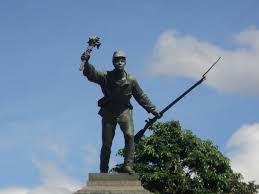
  1. Juan Santamaria is not only the name of the airport central to Costa Rica but the name behind the airport has significant meaning to Costa Rican history. He was a hero of the country. The tail states that he volunteering in efforts to light the enemy’s hostel on fire after many before him were unsuccessful. Significantly, he was able to light the hostel and lead to the victory in Rivas, Nicaragua. The victory in Rivas lead to Costa Rica’s victory in the war against Nicaragua. While he did not live after the fire his legacy continues with national holidays, countless art, and renaming of the International Airport.
  2. José María Castro Madriz born  September 1st, 1818 in San José and died on April 4, 1892. He was a Costa Rican lawyer, diplomat and president for two terms and founded the Republic of Costa Rica. His love for politics began at a young age and later with his presidency declared the country independent. He was later re-elected and promoted improvements in public education and integrated Costa Rica’s first telegraph. He was also a strong voice for the freedom of the pressand married the women responsible for the creation of the Costa Rican flag. Together the couple was responsible for the morals Costa Rica upholds today.
  3. Chavela Vargas is a native born and raised Costa Rica who sang Mexican ranchera music. Compared to a her dear friend, Frida Kahlo, she combined her love, melody and rhythm of her knowledge of traditional Costa Rican folk music with Mexican ranchera music. She broke the ideal image of a women during the time as she many times sang and spoke about her love for women, drinking and smoking cigarettes. The power behind her music promoted a “non traditional” image of hispanic women and an uprise in gender bending musicians continued in her legacy. Finally, Vargas died August 5th, 2012 and left familiar songs such as “La Llorona” and “Paloma Negra” to be replicated dozens of times.
  4. Keylor Navas is an international goalkeeper that was born in San Jose, Costa Rica. He played for a recognized Costa Rican soccer team called “Saprissa”and currently plays for Real Madrid in Spain. He has become a role model for young soccer players and promotes to follow your dreams even know people believe the odds are stacked against you. He also plays on the Costa Rican national team and was named CONCACAF Gold Cup Best Goalkeeper in 2009.
  5. Claudia Poll was born on December 21st, 1972 and is the only gold medalist of Costa Rica. She won the in the 1996 Olympics, the 200 meter freestyle swimming event to clinch the first ever gold medal for Costa Rica.  Claudia won two bronze medals in the 2000 Olympic swimming event. Silvia Poll won the first ever Olympic medal for Costa Rica. In addition, she won the silver medal in the 1988 Olympic Games in the women’s 200 meter freestyle.Both sisters have set national records and inspired young swimmers to continue and pursue their dreams in swimming. Besides their swimming ability have maintained a platform for young professional women with their significant work for female advocacy.
Juan Santamaria Statue

Keylor Navas
Chavela Vargas with her guitar

Journal 4: Low vs High Context Communication

Contextual cultural dimension is differentiated in our Maximizing Study Abroad book as low-context and high-context communication across cultures. Both styles of communication are significant in differentiating with familiar and unfamiliar cultures and examine further impact that it has on communication.

Low- context communication is when we rely minamaly on cues from a context. An example of this can be if you grew up in the U.S it is quite possible that we have been using low-context communication all of our life. This is significant to our studying abroad trips because this communication tends to more verbal and explicit. In the U.S people do come from different cultures and ethnic backgrounds and the tendency is to rely heavily on verbal explicit communication. In order words, we tell people what we think they need to know in order to understand us and then we will fill in the blanks. The goal is to clarify communication and the importance of verbal communication.

High-context communication is when people pay a lot of attention to the situation they are in, the environment, and the people with whom they are communicating with. This also means that there is a high reliance on cues from the context in which someone is in. However, things don’t have to be spelled out as much as they are in low-context cultures because it relies heavily on nonverbal cues. This also means that you don’t have to worry so much about explaining everything since people will have a good understanding just from context itself. An example of this may be when you are talking with a close friend who knows you well in a situation and you don’t have to worry about saying much because they are able to understand your ideas and have background on you. Contrary to low-context communication, nonverbal cues are much more significant for conveying a meaning in high-context cultures. This may pose as a problem when going to a low-context culture because you may assume that others, much like your friends back home, will not be able to relate to you with no background knowledge on you.

In regards to my study abroad experience, I will be able to use my understanding of the low and high context communication styles and keep them in mind when encountering natives of Costa Rica. This is significant because I will be able to communicate across cultures other than just the United States. There will most likely be times where the high-context meets low-context and I will struggle to know what is going on and must use this knowledge to power through tough situations. However, I believe that my background knowledge while living in Costa Rica as a youngin will provide an advantage in the sense of communication styles. I also think that if I ever were to get stuck in a situation that I don’t understand I would be able to use my knowledge of context clues will allow for a last resort in a situation where I am stuck.

Journal 3: What am I intrigued by? and What will be challenging?

Sign with the word help in a hand icon in cartoon style on a white background

Some ideas that I have found intriguing as I read the cultural differences in our Maximizing Study Abroad book, were how to differentiate from personal and universal differences.

Personal differences can be examples such as: walking instead of taking the bus, or sleeping with the light one. I didn’t realize that such differences could be categorized as personal rather than universally known. Some personal differences while in Costa Rica that I will be shown will be preferences to transportation. Either taking the bus, taxi, or other public transportation rather than driving a car or motorcycle will be something I can definitely ask my host family. While I am familiar with Costa Rica, I think I will struggle with the fact that I will be living with someone other than my family. Freedoms such as driving a car or riding a bike won’t be offered to me in the same way as when I stay with my family. I will have to take more public transportation than I am use to even while in the US. I won’t lie, that does make me a bit nervous just because I don’t even like taking public transportation here I will most likely need to to get around in Costa Rica.

Universal differences can be: respecting your elders, or feeling sorry for stepping on the back of someone’s shoe. These differences are known to all and can be learned by observing behaviors when visiting a country. Respecting your elders I feel may be different for the US culture and the Costa Rican one. In the US we are told to respect our elders but I feel that it is to a degree that we do. In Costa Rica, no matter the situation, if they are right or wrong, you elders are respected. I know that respecting my elders will not be a challenge for myself as I am use to it with my Costa Rican family and my US family.

Some challenges that I believe I will face while in Costa Rica will be typical home sickness. I know I will want my regular food and as a vegetarian I will very much need to be asking questions as to what my food was cooked in, or what each item contains. I am always nervous if I eat out that my food could come in contact with meat. Also, another question I get a lot as a vegetarian is if I eat fish or eggs. In Costa Rica, even when I have visited, I make an exception to eggs. I will eat them on their own or in food but at home I do not. I also do not eat fish and I believe that that will be a bit of trouble because it is a country with a large fishing population. Dietary needs will most definitely be a challenge as well as stereotypes of Americans. While in Costa Rica, I want to look, act, and be everything a Costa Rican is like. I am going to stay away from the stereotypes of Americans which are: that they are loud, entitled, and that we are self-centered. While those can be generalizing I feel that with the large amount of American travelers in Costa Rica there is an understanding and not stereotypes of Americans that will be seen as negative.