Blog 9: A key event

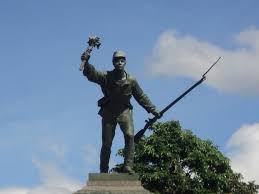
Juan Santamaria Day is a key event in Costa Rican history. As I presented Juan Santamaria in another blog post about important Costa Ricans, I think it be important and significant that I speak about an important day that is very much celebrated still in Costa Rica. Juan Santamaria Day is celebrated every April 11th with grand celebrations. Depending on the area of the country it is celebrated differently however a party is held regardless. The day celebrates the victory of Costa Rica’s Juan Santamaria at the Battle of Rivas against U.S Citizen William Walker. William Walker had already overthrown the Nicaraguan government and was heading further into Central American countries. Due to Juan’s bravery the victory is still celebrated today regardless of the country’s No Army stance.

Celebrations are spread out in Costa Rica with parades, parties, dances, and concerts. The largest parties are held in the Alajuela, were Juan Santamaria was born and raised and are a must to participate in if you are there in April. Little drummer boys dress and march with flags, representing the love and devotion to the nations hero. Drums are a crucial aspect of the celebrations as Santamaria was just a drummer boy and became the hero he is today. Music and hand-made drums of any kind are marched and played throughout the streets. Attractions such as trapezists, dancers, and school groups all march the streets to celebrate the glorious day. The day may be compared to the 4th of July in the U.S with different school bands and students marching the streets and throwing candy, to paint a picture of the day. The national colors: blue, red, and white are wore through different uniforms and traditional Costa Rican clothing. The day is typically very hot and parties begin throughout the day. In provinces such as: Puntarenas, Limon, and Guanacaste, the more beach provinces parties take place on boats with large sails throughout the ocean. Each provinces has different celebrations for the day and because school is still in session, student craft days before the big event. I remember as a kid in private school in Costa Rica we were taught about the day and made different drawings and pictures for our parents. We were taught about the battles and the highs and lows of the fighting in Central America while in the US we’re are just taught the nice and sheltered version of history. The reality of how Juan Santamaria saved Costa Rica was always taught to us as kids and is very much expresses through the festivities of the day.
Blog 8: Government

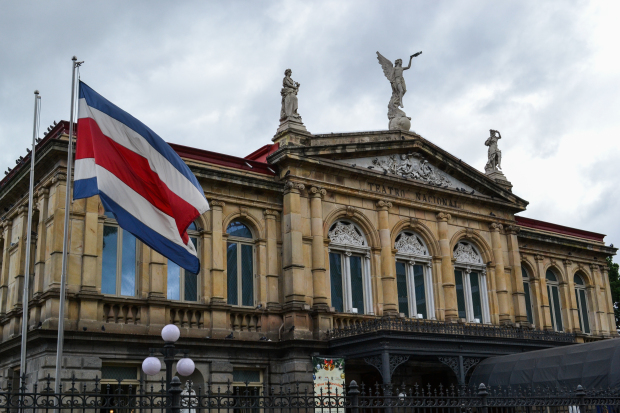
Costa Rica, like I have said many times is known to be the Switzerland of Central America. They are a “democratic, free and independent republic”. Similar to the United States, they have three separate but equal supreme powers:  Executive Power, Legislative Power and Judicial Power. The current President is Mr. Carlos Andrés Alvarado Quesada and the Vice presidents are Ms. Epsy Campbell Barr and Mr. Marvin Rodríguez Cordero. Firstly, I know this will never happen in the US but the president and I have the same last name! Which I think to be pretty awesome and the fact that there is a woman vice president.

The Executive Branch is structured similar to that of the US. It is run by the President, their vice presidents and cabinet. The President elects his vice presidents and cabinet as they serve their term, which is elected by popular vote. Costa Rican presidents as of 2005 were only allowed to serve one term, but with Oscar Arias Sanchez, who had served as President 1986 caused for the reformation of the Constitution. Presidents, if re elected, are allowed to serve more than one term. However, they catch with that is that they must sit a term out and then be re elected. The terms cannot be won consecutively as well as served consecutively. Since then, Oscar Arias Sanchez, has been the only President to be re elected and who the Nobel Peace Prize. The roles of Presidency are limited, which is not the case in the US. They cannot veto the legislative budget however, they are able to appoint whomever they want to their cabinet without Congress’s say. In regards to the two vice presidents, which is similar to that of the US except we call one “Secretary of State”.

The Legislative Branch holds 57 seats in it. Members are again, elected by popular vote to serve four year terms. In comparison to other countries in Central America, Costa Rica’s Legislative Branch has more power than any other country has given to theirs. The Commission is divided into six and are responsible for reviewing proposed laws. Each Commission section have specific branches on laws that they will review. These sections are: Agriculture & Natural Resources, Economic Affairs, Government & Administration, Budgeting & Taxation, Judicial Affairs, and Social Affairs. I think this is significant to note as I do not believe the US has a system so organized. Members are organized as well. There are a set amount of seats that are set aside for women, and other minority groups for their representation as well. I found this to be amazing! Why is that not a concept that we in the US consider? I know why! Because we love white men in power, that’s why!

Finally, the Judicial Branch is the legal system in Costa Rica and completely independent from the other two branches. There are three levels of court: district, appellate and supreme. All fairly simple to understand as the deeper you get in court, the higher you go up in the levels of court. However, the Judicial Power is exercised by the Supreme Court of Justice, who is currently: Carlos Chinchilla Sandí. The Supreme Court of Justice is allowed an eight year term and may be re elected, consecutively for potentially their who life.


Blog Post: Fooooood

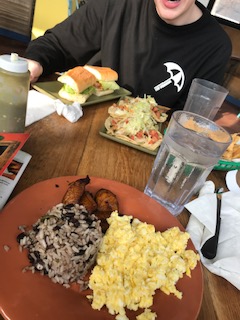
I traveled to the only Costa Rican restaurant in the Chicagoland area. It is called Irazu and is in Bucktown and not to far of a bus ride from the train station. I went and felt like I was at home. I ordered many things but 3 that were my favorite were: patacones con frijoles (English: smashed and fried plantains with beans), gallo pinto (English: white rice and beans with eggs) and yuca fries.

Patacones con frijoles is a typical Costa Rican appetizer that I as a kid and still eat as a full meal. The plantanes are smashed into circle-like shapes and then fried either with a ton of oil on a pan or deep fried. They are then plated next to a bowl of refried black beans to either dip or put on top of the plantains. The beans are refried, smashed black beans, seasoned with salt and unions. Typically Costa Rican food is not spicy at all and the food at Irazu was very well made. They went together perfectly even though the plantains were a bit over cooked.
Next, the gallo pinto was my favorite dish at the restaurant. I am a vegetarian and I typically never eat eggs but I felt that I should give it a try. I normally just eat eggs on their own when I am in Costa Rica because I feel that they are healthier and fresher. Gallo Pinto is a traditional breakfast meal and so far from what is typical of breakfast in the US. Gallo pinto is white rice and black beans with eggs. I prefer to have scrambled eggs but others can have them over easy or  sunny side up. The history behind the rice and beans is that they were most likely leftovers from the day before and they would be mixed and heated over again for breakfast the next morning. The rice is a little firmer and the beans are not as juicy which create the perfect leftovers. The combination of the eggs create a breakfast like meal and thus gallo pinto became a staple breakfast in the Costa Rican household.
Finally, the yuca fries are not just traditional to Costa Rica but of many Caribbean and Central American countries. Yuca fries can be prepared many ways but the most familiar and most seen in Costa Rica are prepared with thick pieces of fried yuca. The fries that were prepared at Irazu were not typical of Costa Rican yuca fries. The fries were thin and deep fried to make more of a chip. I still dipped them in refried beans which is used mostly as a salsa like dish but I was not a fan. The Costa Rican yuca chips are comparable to diced potatoes just to get a better understanding of what they are meant to be like in Costa Rica.

Overall, I very much enjoyed Irazu and will be definitely going back. I was given the opportunity to meet the owner and he gave us a little Costa Rica discount. I was excited to find Irazu and to have my boyfriend join me.

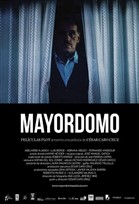
Blog Post: “El Mayordomo”

Costa Rica does not have many movies from their own country but rather has movies translated to spanish from popular movies in the US. However, I did find the movie called El Mayordomo which means “The Butler”.

The movie is about a boy named Peter who is from Costa Rica and received the house of his recently deceased mother. She left the house for him in his will which is very common in Costa Rica for homes to be passed down from generations. The house comes with the butler and his daughter that worked for Peter’s mother and when Peter plans on cleaning out the house he notices that they have something else in mind. The plot thickens when things get creepy. I won’t ruin the movie but I definitely closed my eyes a couple of times.

The movie is rated “Terror” which is “R” in Spanish and I could easily find the movie online, maybe illegally, but found it nonetheless. The movie was released in 2017 and to date is the highest-grossing film in the last 10 years. The film captures many cultural dimensions of Costa Rica. For example, the leaving of the house to Peter is a very culturally hispanic thing to do. In addition, to have maids and butlers is not a concept that only the rich and wealthy have. In Costa Rica, to have butlers or someone to take care of your house is fairly inexpensive and is fairly common. The addition to small supernatural scenes also contrast the religious connotation of Costa Rican audiences and the negative superstitions of the supernatural. The “strange” things that occured to Peter as he stayed in his mother house where not all the “strange” and audiences did not feel that they were going against their religious beliefs by seeing the movie.

Contrast the film is portrayed as a classical film with little to no color in some scenes. The director, César Caro Cruz, makes that irry and scary movie similar to the movie Psycho directed by Alfred Hitchcock with a black and white theme throughout the movie in suspenseful scenes with Peter and the Butler.

I read in a critic of the movie in the “La Nacion” newspaper, that the prediction of the outcome for the movie was not positive. However, critics and the public were surprised that with such a vague title the movie was so successful. The thrill of the movie attracted audiences again and again. In addition, the risk of Cruz to lessen the dialogue between characters, required the best of the best cinematography could buy with the small budget of the film. Many critics applaud the movie as well as myself, if I can even consider myself a critic. I very much enjoyed the movie even though I was scared throughout it. I normally stray away from horror movies that cause me to feel my stomach in my throat, however, because of my pride in being Costa Rican I feel that I owe it to the country to give their own movies a chance.

If you enjoy thriller, and suspenseful scary movies I recommend seeing  El Mayordomo”, maybe with a friend or during the day.

Blog Post: In the News this Week

  • Wednesday (4/24): A 14 year old high school student threats the San Luis Gonzaga high school with the size of a similar Columbine shooting. The police searched his parents home and found a computer, cell phone and USB all pointing to him. The threats were made public via social media platforms and gained the attention of many and police then became involved. The 14 year old wanted to gain historical significance with this shooting and threatened it on social media.
  • Friday (4/26): More details are being shared with the public about the murder of Carla Stefaniak during her stay in an Airbnb in Escazu. Carla was an American and was found murdered near the airbnb rental days after she was last seen. The owner of the Airbnb is communicating with lawyers as the details of the murder unfold. DNA form one murder has been found but due to the nature of murder the family believes that there must have been multiple offenders. The mystery is still not solved but Costa Rican investigators continue to solve the puzzle.  
  • Saturday (4/27): Costa Rica’s Ministry of Labor and Social Security office in collaboration with the company SYKES signed an addendum to an agreement that will train and hire hundreds in the upcoming months, thanks to the SYKES’ English Academy. This means more jobs and education avocation being done governmentally for Costa Rica.
  • Sunday (4/28): The Costa Rican company Vertical CR is awaiting permits to sell medical marijuana. The company sells a plethora of products such as oils, lotions and many more. The Ministry of Health will have to decide if the company is approved or reject the request to commercialize their products. Many Costa Ricans await the approval to sell medical marijuana.
  • Monday (4/29): Monday was the celebration of the rainforest animal the Tapir. The day brought large attention to the endangered species in the rainforest and throughout the world. Tapir is the largest mammal of Central America and is often referred to the “mountain cow”. Their population has more than halved in recent decades, landing them on the Endangered Species list. Tapires can be found in many national parks in Costa Rica and require a day to celebrate their existence. Parks such as Penas Blancas, Monteverde Cloud Forest Preserve, Corcovado, La Selva Biological Station, and La Amistad International Park.
  • Tuesday (4/30): Tourist in Canada are uprising in happiness as Air Canada raises the number of flights to Costa Rica. Canadians are amongst the highest percentage of tourists to Costa Rica and the company has announced that it will begin by extending the 2019 season into September and October. During these two additional months, Air Canada will fly to Daniel Oduber Quirós International Airport in Liberia, Guanacaste for the first time. The extension will allow for a 36% increase in seats and will allow for easier flight to Costa Rica and other airports besides Juan Santamaria International.
  • Wednesday (5/1): The Costa Rican Judiciary Investigative Police (OIJ) find $3 million dollars in US dollars cash, in a China Town building. Five people were detained and questioned for further information on the money. The money was believe to be linked to laundering and was first located by police in August. The arrested are awaiting trial related to drug and laundering charges.

Costa Rican’s that have changed History

  1. Juan Santamaria is not only the name of the airport central to Costa Rica but the name behind the airport has significant meaning to Costa Rican history. He was a hero of the country. The tail states that he volunteering in efforts to light the enemy’s hostel on fire after many before him were unsuccessful. Significantly, he was able to light the hostel and lead to the victory in Rivas, Nicaragua. The victory in Rivas lead to Costa Rica’s victory in the war against Nicaragua. While he did not live after the fire his legacy continues with national holidays, countless art, and renaming of the International Airport.
  2. José María Castro Madriz born  September 1st, 1818 in San José and died on April 4, 1892. He was a Costa Rican lawyer, diplomat and president for two terms and founded the Republic of Costa Rica. His love for politics began at a young age and later with his presidency declared the country independent. He was later re-elected and promoted improvements in public education and integrated Costa Rica’s first telegraph. He was also a strong voice for the freedom of the pressand married the women responsible for the creation of the Costa Rican flag. Together the couple was responsible for the morals Costa Rica upholds today.
  3. Chavela Vargas is a native born and raised Costa Rica who sang Mexican ranchera music. Compared to a her dear friend, Frida Kahlo, she combined her love, melody and rhythm of her knowledge of traditional Costa Rican folk music with Mexican ranchera music. She broke the ideal image of a women during the time as she many times sang and spoke about her love for women, drinking and smoking cigarettes. The power behind her music promoted a “non traditional” image of hispanic women and an uprise in gender bending musicians continued in her legacy. Finally, Vargas died August 5th, 2012 and left familiar songs such as “La Llorona” and “Paloma Negra” to be replicated dozens of times.
  4. Keylor Navas is an international goalkeeper that was born in San Jose, Costa Rica. He played for a recognized Costa Rican soccer team called “Saprissa”and currently plays for Real Madrid in Spain. He has become a role model for young soccer players and promotes to follow your dreams even know people believe the odds are stacked against you. He also plays on the Costa Rican national team and was named CONCACAF Gold Cup Best Goalkeeper in 2009.
  5. Claudia Poll was born on December 21st, 1972 and is the only gold medalist of Costa Rica. She won the in the 1996 Olympics, the 200 meter freestyle swimming event to clinch the first ever gold medal for Costa Rica.  Claudia won two bronze medals in the 2000 Olympic swimming event. Silvia Poll won the first ever Olympic medal for Costa Rica. In addition, she won the silver medal in the 1988 Olympic Games in the women’s 200 meter freestyle.Both sisters have set national records and inspired young swimmers to continue and pursue their dreams in swimming. Besides their swimming ability have maintained a platform for young professional women with their significant work for female advocacy.
Juan Santamaria Statue

Keylor Navas
Chavela Vargas with her guitar

Costa Rica’s Musicians

As we all become a little bit more familiar with Costa Rica, we may ask ourselves how this small country can have small impact on Spanish music with all the music currently being made? In fact, Costa Rica has a large, very large influence on Spanish music. It has a very diverse type of rhythm and sound that can be tied back to its native sounds. Some musicians that I am not even familiar with are: Debi Nova, and Cocofunka. These musicians are native to Costa Rica, whether they were born there, or they are a native band to the country.

Debi Nova is a native born “tica” who currently lives in Los Angeles, California. She is extremely popular with the youth, both English and Spanish youth, and was featured on the EA FIFA 2005 video game with her song One Rhythm. Her songs are popular with the youth due to the fact they mix both English and Spanish in her lyrics and have a pop like sound. She has worked with top Latin artist such as Ricky Martin, Franco de Vita, and Sean Paul. Her music is best described as a mixture between latin pop and latin dance music. Debi was also involved in six Grammy nominations and has excelled in the music industry and continues to work and put out music while in Los Angeles.

While I am not familiar with Debi Nova, I will be sure to do a little more investigating and start to listen to her music. While I am hesitant to listen to her music because I do see that her most recent music is mostly in English, I will be sure to give her a chance and start with her Spanish songs first. I mean, she is a “tica” and us “ticas” have to stick together and support each other.

The next group I was very excited to find out about was Cocofunka. The group name in itself seems like it would come from the rainforests of Costa Rica. Cocofunka is a band composed of six musicians all from Costa Rica. The band got together in 2008 and has since put out many EP’s such as: La Criminal, Elevante, and Chucaro. Cocofunka has performed strictly in Costa Rica and promote themselves an innovative mixture of latin sound. The group has been approached by many popular manager, they have yet to work with someone outside of the country due to their fear of losing their original sound. The group has performed at the University of Costa Rica, and La Sabana (a central park in Costa Rica) and has brought in crowds of students and fans to watch them perform. However, Cocofunka is still a small group, compared to Debi Nova, but they are creating and building a platform for themselves in Costa Rica.

I am excited to listen to this group because I feel that they will be more original and native to Costa Rican sound. The group has a Facebook group and can be found on Spotify for many of their songs.

Costa Rica’s Economy

Costa Rica’s economy has grown since 2017 with the growth in exports such as bananas, coffee and sugar. These exports are, globally, benefiting nations across the world. Bananas, coffee and sugar are some of the most exported products of Costa Rica but in a growing age of technology that are now also a lead in electronic exports. Products such as cars, medical instruments, computers, and broadcasting equipment are shipped worldwide to countries such as: United States, China and Netherlands. Not only does Costa Rica produce massive amounts of exports but they also, within the country, offer a rich biodiverse land which upholds a major ecotourism destination for many. Ecotourism is a major part that upholds the economy of Costa Rica and allows for it to continue prospering.Ecotourism has helped expand agriculture, and other electronic industries. According to Ricardo Valverde Sanchez of the University of Costa Rica, the assistance that ecotourism has helped the country is astonishing. He states, “Tourism directly accounted for 5.4% of Costa Rica’s gross domestic product (GDP) in 2015.”  Such policies contribute both positively and negatively to the growth economically. However, a country that prioritizes such policies have ultimately showed how important the environment is rather than capitalism.  

Geographically the significance of rainfall has allowed for such fertile soil that the continuation of agricultural growth. Almost one fourth of the country is preserved for natural preservation with sites ranging from beaches to rainforests and has become also a hotspot for retirees around the world, another economic sustainability that allows for Costa Rica’s economy to grow. While Costa Rica was for many years and some may even say continues to be a very socialist nation the growth within the country has changed gears for Costa Rica in a more capitalistic nation. A country that is very prideful of their “No Army” slogan and in 2018 ranked first in Latin America and 12th in the World Happiness Index it could seem that Costa Ricans got it down pat economically. In addition, the rich environment captures attention of many ecological friendly policies such as their 2015 pledge to be a carbon neutral country by 2021.

My own relevant experiences have also been nothing but positive in Costa Rica. Growing up in there, I was accustomed to free health care, free public education and abundance more thanks to the economic growth of the country. What Costa Rica is offering for its citizens, incoming immigrants, tourists and everyone who visits, is an experience that I hope to learn from. From a country very different from the United States economically the growth of Costa Rica may gear towards a more capitalistic United States. Of course, someone who may have a more capitalist approve economically could say how Costa Rica is still a developing country and cannot be compared to such a large nation much like the United States. Ultimately, the fact that Costa Rica is growing and becoming recognized worldwide for its work environmentally, and socially must be an achieved goal or a goal set by other countries in similar positions.